
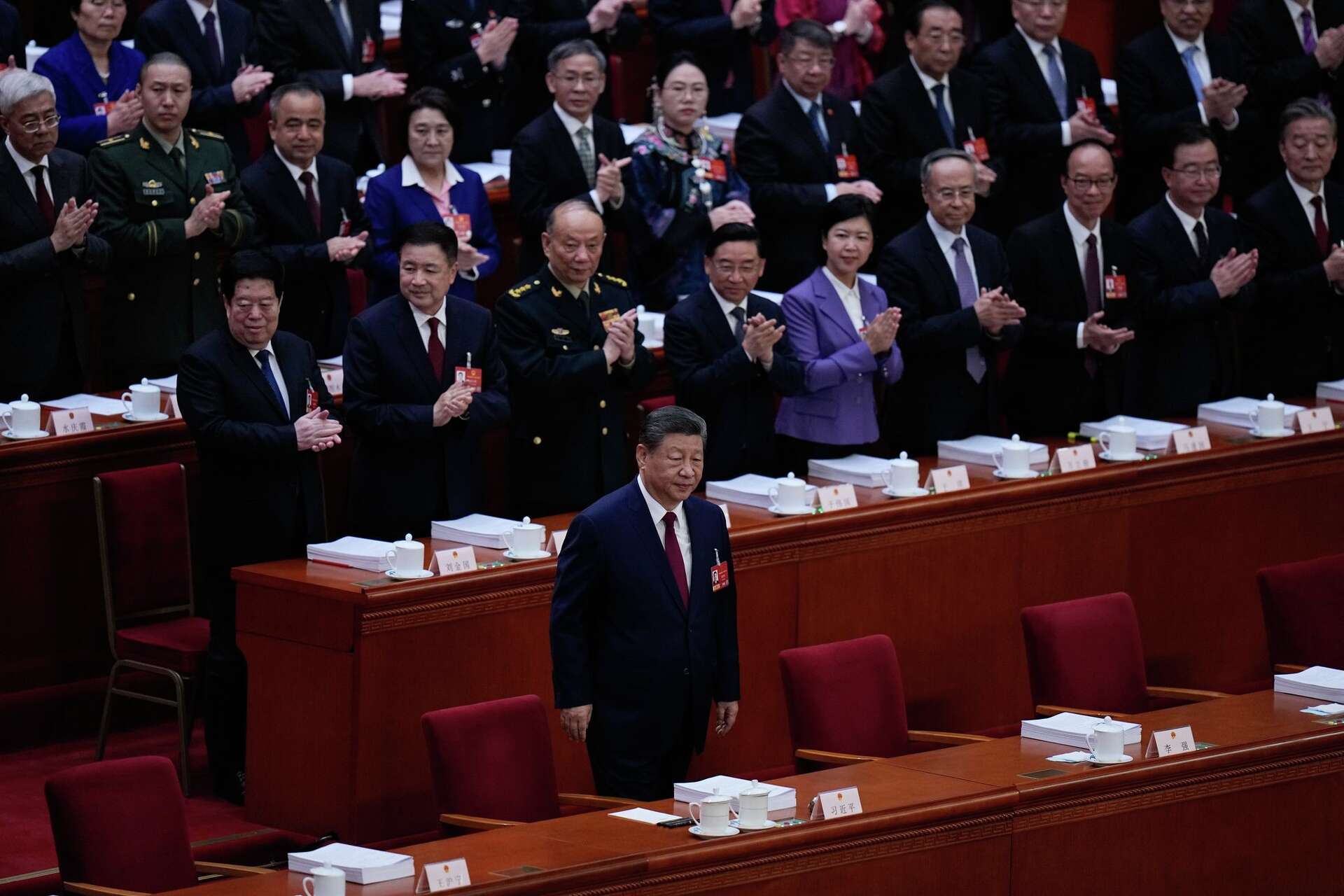
Thousands of delegates gathered under the vaulted ceilings of the Great Hall of the People in Beijing on Thursday for the opening session of China's National People's Congress — the annual political gathering where the Communist Party formally unveils its economic priorities and legislative agenda for the year ahead. This year's session carries unusual weight. The NPC formally launched the 15th Five-Year Plan covering 2026 to 2030, setting China's development roadmap for the back half of this decade. And in the centerpiece announcement of the week, Premier Li Qiang delivered the GDP growth target for 2026: a range of 4.5% to 5%, the lowest China has publicly committed to since the early 1990s — a record low since the country began announcing such figures, barring 2020 when officials chose not to set a target at all due to the COVID-19 pandemic.
The downward revision from three consecutive years of targeting "around 5%" is more than a statistical footnote. It is an acknowledgment, stated with unusual candor, that China's economy faces structural challenges that government stimulus alone cannot quickly resolve. "Rarely in many years have we encountered such a grave and complex landscape, where external shocks and challenges were intertwined with domestic difficulties and tough policy choices," Li told delegates. The premier's language was a striking departure from the confident rhetoric that typically characterizes these sessions.
The headwinds are real. China has entered its fourth consecutive year of deflation. The property sector — which once accounted for between 25 and 30 percent of GDP — plunged 17.2% in investment last year and remains in its fifth year of crisis. Fixed-asset investment overall declined 3.8% in 2025, the first annual decline in decades. Retail sales grew only 3.6%, reflecting the weak consumer confidence that policymakers say they are urgently trying to address. Factory-gate deflation deepened to negative 2.6%, eroding corporate margins and compressing incentives for new investment. The urban unemployment rate stood at 5.2% at year's end; the government is now targeting a rate no higher than 5.5% and aims to create 12 million new urban jobs this year.
The 15th Five-Year Plan submitted to the Congress for approval outlines a vision that pivots away from the real estate and heavy infrastructure model that powered China's growth for two decades, and toward advanced manufacturing, artificial intelligence, and domestic consumption. The government's "AI Plus" initiative will receive substantial new resources, with officials forecasting the AI-related industry will surpass 10 trillion yuan in value by 2030. Six emerging sectors are identified as pillar industries for the plan period, including integrated circuits, intelligent robotics, low-altitude drone economy, biomedicine, aviation, and aerospace. High-tech manufacturing contributed 26% of China's industrial growth last year and is expected to become a larger share over time.
Complicating everything is the war in the Middle East. Like most of Asia, China depends heavily on oil and natural gas from the Gulf region, and the disruption of shipping through the Strait of Hormuz — which Iran's Revolutionary Guard briefly declared "closed" at the start of the conflict — has driven energy prices sharply higher and introduced supply uncertainty into planning scenarios. China's Foreign Minister Wang Yi held phone calls with both Iranian and Israeli counterparts last week, casting Beijing as an active mediator seeking a ceasefire. At the same time, preparations continue for a planned visit to China by President Trump later this month, where trade tariffs, export controls, and the Taiwan question are all expected to be on the agenda. The visit will be a significant test of whether the world's two largest economies can maintain stable communication even as the international system convulses around them.