
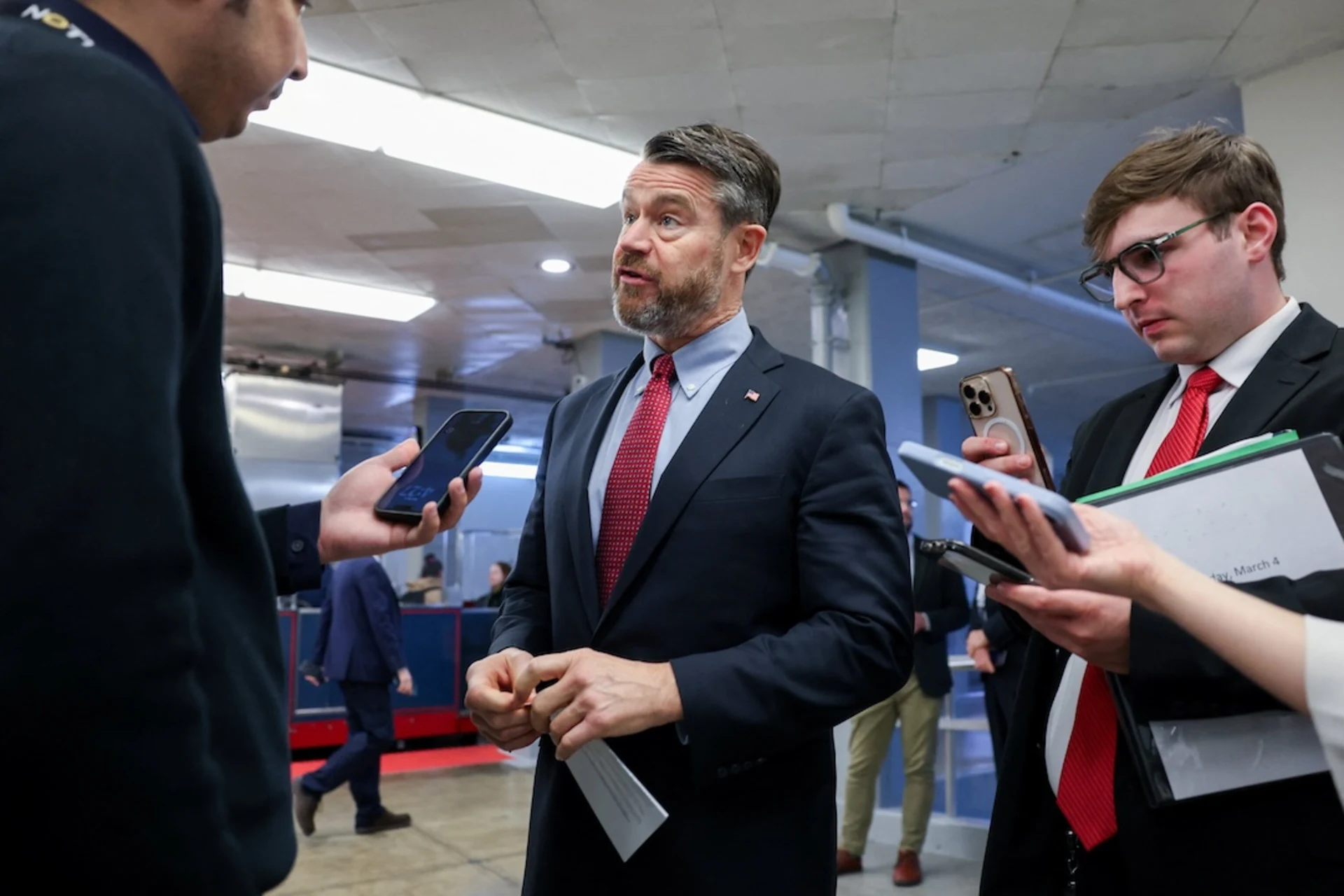
The United States Senate voted this week to reject a bipartisan resolution that would have required President Trump to seek formal congressional authorization before continuing military operations against Iran — cementing, at least for now, the president's virtually unchecked authority to prosecute a conflict that is now nine days old, has killed seven American service members, and is generating consequences that are beginning to reach every corner of domestic life in the United States.
The vote on the war powers resolution, introduced jointly by Democratic Sen. Tim Kaine of Virginia and Republican Sen. Rand Paul of Kentucky, was 53-47. It needed 60 votes to advance. Sen. John Fetterman of Pennsylvania was the only Democrat to vote against the measure, while Paul was the only Republican to cross the aisle in support. The resolution would have invoked the 1973 War Powers Resolution, which requires the president to obtain congressional authorization within 60 days of committing U.S. armed forces to hostilities. Critics of the Trump administration's legal reasoning argue that the Iran strikes — launched February 28 without a congressional vote, just days after American diplomats were congratulated by Omani mediators for a "breakthrough" in indirect nuclear talks with Tehran — represent precisely the kind of unilateral executive military action the War Powers Resolution was designed to prevent. Congress has not officially declared war since World War II, but presidents of both parties have used a succession of legal authorities to conduct military operations without legislative approval.
The human cost of the conflict continues to rise. The Department of Defense confirmed this week the death of a seventh American service member, a soldier who died in Saudi Arabia from wounds sustained in an Iranian drone attack. Six Army Reserve soldiers were killed the previous week when an Iranian drone struck a command center in Kuwait. President Trump and Vice President Vance attended the dignified transfer ceremony for those six service members at Dover Air Force Base. Defense Secretary Pete Hegseth told reporters the conflict was far from finished: "We have only just begun to fight," he said, adding that U.S. firepower was "about to surge dramatically."
The most alarming intelligence development of the week came from a CNN investigation published Saturday, which reported that Russia is providing Iran with intelligence about the locations and movements of American troops, ships, and aircraft, based on multiple people familiar with U.S. intelligence reporting. Much of the intelligence Russia has shared with Tehran consists of imagery from Moscow's sophisticated satellite constellation — a capability that could dramatically improve Iran's ability to target U.S. military assets in the region. It is not clear whether any specific Iranian attack can be definitively linked to Russian targeting intelligence, and the Kremlin did not respond to requests for comment. The revelation represents the first indication that Moscow has sought to actively intervene in the conflict on Iran's behalf, and it significantly complicates the strategic picture for American military planners.
At home, the war is having measurable and immediate effects on everyday American life. National gasoline prices have surged to their highest level in roughly two years, approaching $4 per gallon on average, as shipping through the Strait of Hormuz remains severely disrupted and global oil markets price in the risk of prolonged conflict in the world's most critical petroleum transit corridor. Energy analysts warned this week that prices could climb further if the conflict expands or if additional Gulf oil infrastructure is damaged. Polling released this week showed declining public support for the administration's handling of the Iran campaign, with a majority of Americans saying they believe the military action should have required prior congressional approval. With the 2026 midterm election season already underway — Texas held its primaries just days ago — those numbers will be watched closely by candidates in both parties in the weeks ahead.